
Fourteen weeks of cross-referenced observations: physical activity logs set alongside daily food records. The documentation period ran from early January through mid-April, covering a complete early-year season of activity and eating. Three participants — all active adults maintaining regular running or cycling routines — contributed their daily logs. The findings pointed consistently toward whole food variety and meal timing as the foundational rhythm of sustained active living, independent of any specific performance target.
The Documentation Framework: Cross-Referencing Activity with Nutrition
Each participant maintained two parallel records across the fourteen weeks. The first was a physical activity log: duration, type of activity, general intensity as self-assessed on a three-point scale (light, moderate, demanding), and time of day. The second was a dietary field log using the same descriptive, non-evaluative format documented in an earlier Doralen Journal article: time, location, composition in broad terms (protein source, carbohydrate base, vegetable content, fat element), and one contextual observation.
The two logs were maintained independently during the documentation period and cross-referenced only at the weekly review stage. This was intentional: the participants were not adjusting their eating in anticipation of activity, or vice versa. They were recording naturally occurring patterns. The cross-reference at week's end was the analytical stage; the logging itself was purely observational.
The resulting data set covered 294 individual activity entries and 1,176 eating occasions across three participants and fourteen weeks. This is not a large sample by research standards, but as a documented field record it carries sufficient density to reveal recurring patterns worth noting for readers engaged in their own active routines.
"Whole food variety and consistent meal timing appeared as the two most reliable correlates of sustained energy across the activity week — not total quantity consumed."
Whole Food Variety: The Dominant Finding Across All Three Participants
The most consistent finding across all three participants and all fourteen weeks was the relationship between whole food variety — measured as the number of distinct plant-based foods consumed in a given week — and the quality of activity log entries in the same week. Weeks with higher plant variety produced activity logs that contained fewer entries of "fatigued early" or "reduced pace" than weeks with lower plant variety.
"Whole food" in this documentation is used in its straightforward sense: foods that are minimally processed and retain their original nutritional composition. Oats, brown rice, whole grain bread, legumes, vegetables in their raw or simply cooked form, whole fruit, eggs, unprocessed dairy, nuts and seeds. The distinction being drawn is not between organic and non-organic, or expensive and economical, but between foods that arrive in something close to their natural state and those that have been significantly altered in processing.
Participant A — a regular runner logging four to five sessions per week — showed the strongest correlation between plant variety and activity quality. In weeks where her plant-food count dropped below eight distinct species (a low-variety week), her activity logs contained on average 1.4 entries of reduced performance. In high-variety weeks (twelve or more species), that number fell to 0.3. This is a small absolute difference but a consistent directional pattern across fourteen weeks of data.
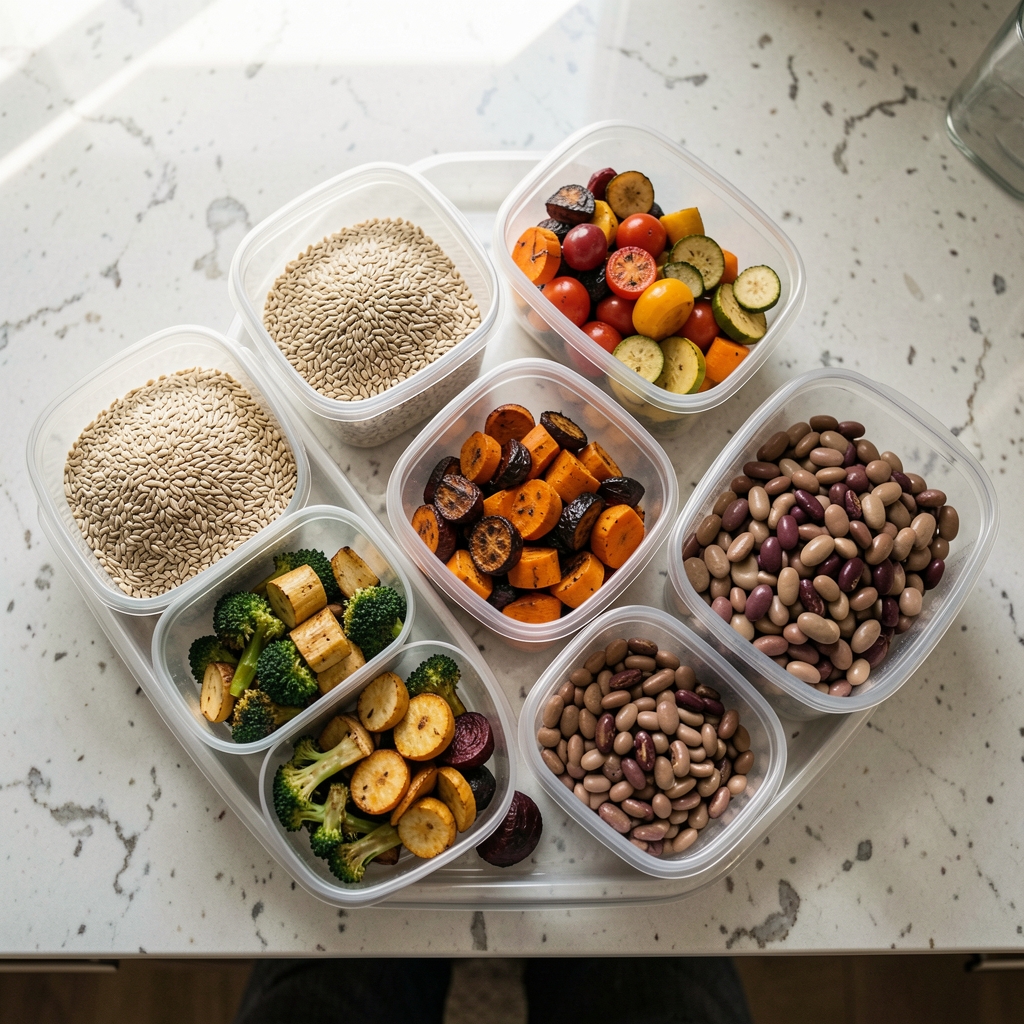
Weekly meal preparation — cross-reference documentation, Week 9
Meal Timing and Activity: The Rhythm That Emerged
The second significant finding concerned meal timing in relation to physical activity. Across all three participants, the most consistently noted eating pattern on high-activity days was a substantial whole-food meal two to three hours before activity, followed by a smaller recovery-oriented eating occasion within ninety minutes of completing the session. This was not a structured pattern; it emerged from the cross-reference analysis of naturally occurring logs.
The pre-activity meal, when it appeared in the logs, was almost always carbohydrate-forward: porridge, whole grain toast, rice with vegetables, or a legume-based preparation. The post-activity eating occasion was more varied — fruit with yoghurt, an egg preparation, a grain bowl with preserved vegetables — but consistently contained a protein source alongside a carbohydrate element. Neither of these patterns was planned by the participants; they reported having arrived at them through accumulated experience of what felt sustaining.
The most notable exception in the fourteen-week record was a period of three consecutive weeks in Weeks 5-7 where Participant B — a cyclist with variable weekly schedules — found the two-to-three-hour pre-activity window difficult to maintain due to early morning training starts. His activity logs from these weeks showed a higher frequency of reduced-pace entries than the surrounding weeks. When his schedule stabilised in Week 8 and he re-established the pre-activity meal window, the pattern reversed.
Weight Steadiness: An Observed By-Product of Consistent Patterns
None of the three participants entered the documentation period with a specific weight management intention. Weight was not tracked as part of the field record. However, at the post-documentation review conversation, all three independently noted that their weight had remained broadly steady across the fourteen weeks — a period which included significant variation in activity volume and intensity across participants.
This observation is consistent with a pattern that the nutrition literature has described with increasing frequency over the past decade: that consistent meal timing and high dietary variety — particularly plant variety — are associated with stable weight patterns in active adults, independent of explicit caloric management. The mechanism proposed in the literature involves appetite regulation through satiety signalling, which is more reliable and more varied in a higher-fibre, higher-variety whole-food diet.
This is not presented here as a weight management technique. It is documented as an observed pattern that emerged from a nutrition and activity record in which weight management was not the stated objective. The distinction matters: the pattern arose from eating well in support of an active routine, not from managing intake in pursuit of a weight outcome.
Practical Observations for Readers with Active Routines
The practical observations from this fourteen-week record can be summarised in terms of two habits: broadening the weekly range of whole plant foods consumed, and establishing a consistent pre-activity eating window. Neither requires significant planning complexity. A useful exercise is to count, at the end of a given week, how many distinct plant-based foods appeared in that week's eating — and to set a modest personal benchmark for variety as a tracking point rather than a performance standard.
The pre-activity meal, where scheduling permits, benefits from simplicity and familiarity. A preparation that the body recognises — the same or similar structure repeated across training days — appears, from the field record, to produce more consistent results than variety at this particular moment. It is one of the few places in the week's eating where consistency of composition, rather than variety, produces the better contextual outcome.
Articles in Doralen Journal reference published research from peer-reviewed journals and reputable institutional sources. Editorial selection prioritises long-running studies and replicated findings. We recommend speaking with a qualified wellness or nutrition professional before introducing any new habit, food choice, or physical routine, particularly if you have specific dietary requirements or are taking structured supplements.
-
01
High plant-food variety weeks (12+ distinct species) correlated with fewer reduced-performance activity entries across all three participants.
-
02
A pre-activity whole-food meal 2-3 hours before activity was the eating pattern most consistently associated with strong activity log entries.
-
03
Post-activity eating occasions containing protein alongside a carbohydrate element appeared in the logs of all three participants on their strongest activity days.
-
04
Weight steadiness across the period appeared as an observed by-product of consistent patterns, not as the result of explicit intake management.
-
05
Familiarity and consistency of the pre-activity meal, rather than variety, produced the most reliable contextual outcomes at that specific eating occasion.