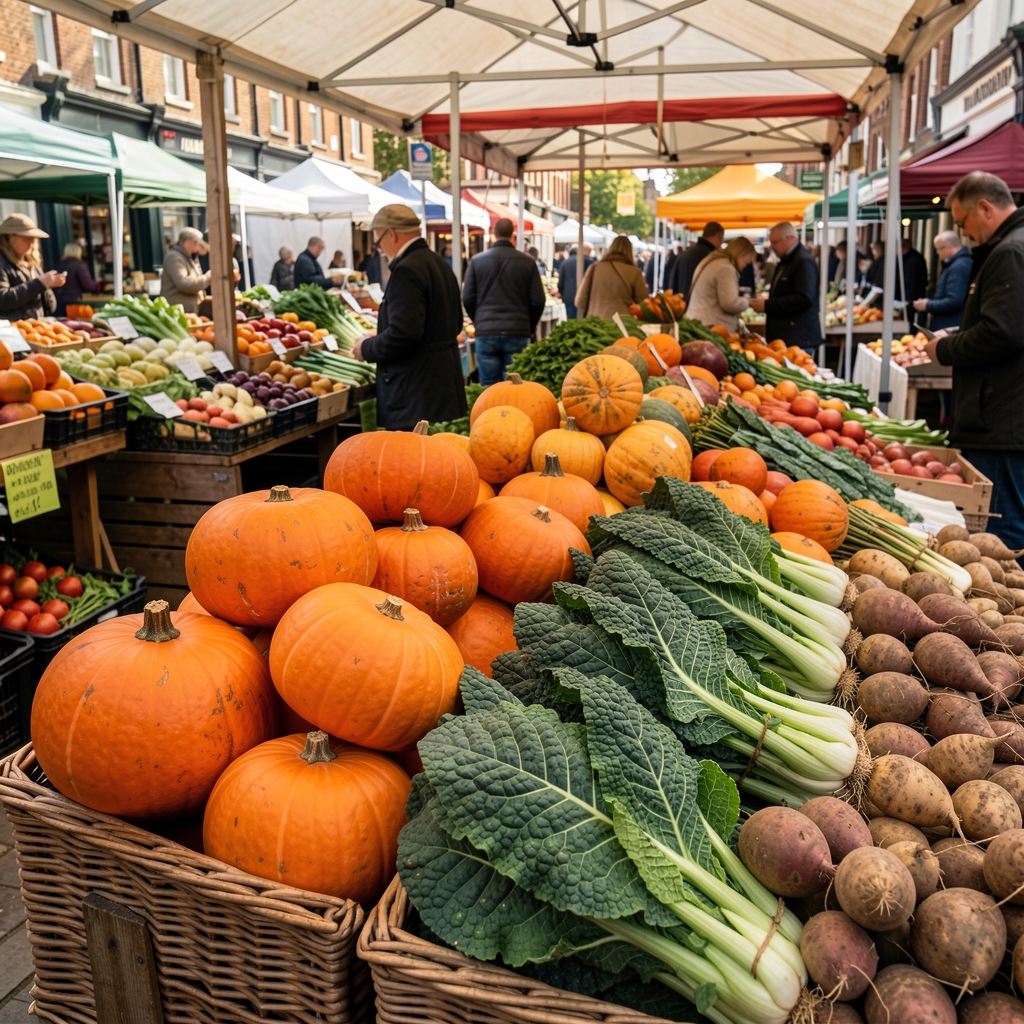
Across three seasons of documented market visits in central London, a recurring pattern emerged: the plates built around what was ready — not what was convenient — held together with greater consistency. The record covers Borough Market in autumn, a Bermondsey Saturday stall in winter, and a Fitzrovia co-operative shop from March through May. Each visit was logged. Each plate was noted. What follows is a drawn account of eating with the calendar rather than against it.
Autumn: Root Vegetables and the Architecture of a Balanced Plate
The autumn visits produced the widest variety. A single Borough Market circuit in late October yielded nine distinct root varieties — celeriac, heritage carrot, parsnip, turnip, swede, kohlrabi, Jerusalem artichoke, beetroot, and purple sprouting. The pricing followed availability closely: celeriac at 60p per head, heritage carrots at £1.20 per bunch. What the market supplied was, in that moment, the most nutritionally varied and cost-efficient basis for the coming week's plates.
The constructed plates from these visits followed a consistent structural pattern: a dense root base occupying roughly half the plate area, a protein element from eggs, legumes, or occasionally cheese, and a leafy addition — kale, chard, or cavolo nero — filling the remaining quarter. Dressings were built from cold-pressed oil, cider vinegar, and mustard. No ingredient was repeated within a four-day window. The variety was not a consequence of planning so much as the natural output of working with what was available.
The observations noted over this period were consistent with published research on dietary variety: when the range of food sources is wide, the likelihood of a nutritionally adequate intake over a given week improves without the need for precise, gram-by-gram tracking. The seasonal market, in this respect, functions as a passive planning mechanism. The constraint of what is available becomes an organisational asset.
"The constraint of what is available becomes an organisational asset — the seasonal market as a passive planning mechanism."
Winter: Brassicas, Fermented Staples, and the Quiet Logic of the Short List
Winter narrowed the available range to a shorter list: various kales, savoy and pointed cabbages, leeks, onions, and stored root vegetables from autumn harvests still moving through the distribution chain. The Bermondsey Saturday stall in January carried fourteen lines; Borough Market in the same week offered perhaps twenty-two. The contrast with autumn was notable and, initially, felt like a constraint on plate building.
The adjustments made were incremental. A greater reliance on legumes — lentils, dried chickpeas, haricot beans — brought back protein variety and bulk. Fermented additions, particularly a local sauerkraut from a Bermondsey producer and a plain unsweetened yoghurt from a Somerset dairy, contributed both flavour contrast and the practical benefit of variety at low cost. A cabbage-based construction — braised, then finished with a grain, a legume, and a sharp dressing — became the winter's recurring anchor dish.
The findings here were instructive: a shorter ingredient list does not necessarily produce a nutritionally narrower plate, provided the structural logic remains sound. The key variable was not the total number of different foods available but the deliberateness with which the available foods were combined. The winter record produced some of the most nutritionally dense plates of the full three-season log.
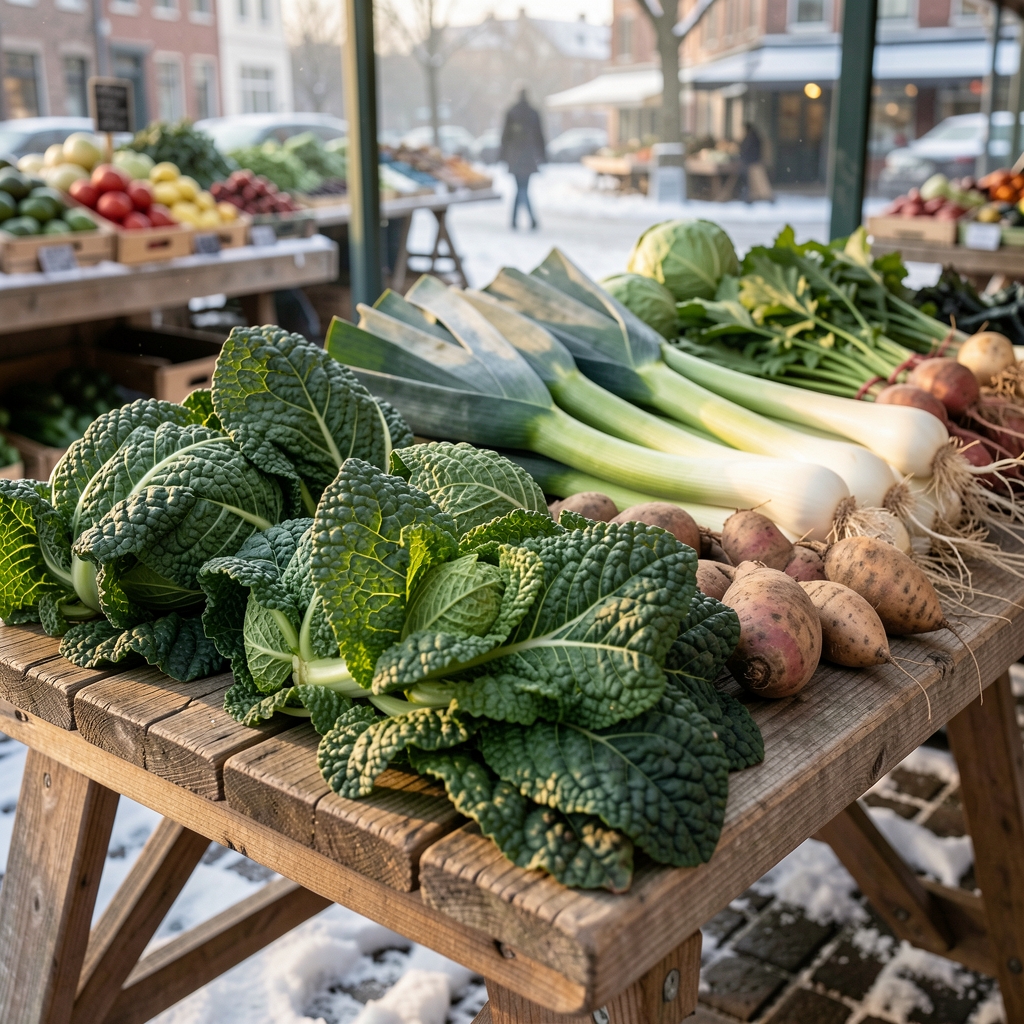
Bermondsey Saturday Market, January 2026 — field documentation
Spring: Alliums, Greens, and the First Return of Variety
The shift from late February into March was observable at the Fitzrovia co-operative shop before it was visible at the larger markets. Wild garlic appeared in the first week of March, followed by early purple sprouting broccoli and forced rhubarb. The change was gradual rather than sudden, and the plates built around it followed accordingly — a slow reintroduction of green range after three months of relative brevity.
Spring alliums — spring onions, garlic shoots, chives — brought a flavour register that the winter plates had lacked. They were used raw in most preparations: as garnish, as textural addition, or as the primary aromatic in a vinaigrette. Combined with the first asparagus (appearing at the co-op from late April at a premium cost point), the plates of this period were both the simplest and, in terms of ingredient quality, the most distinguished of the three-season record.
The broader observation from the spring window concerns the relationship between ingredient quality and portion planning. When produce is at its seasonal peak, the flavour density is higher per unit weight, which tends to support more attentive eating. The plates built from spring market visits were consistently smaller in total portion size than the winter constructions, yet the recorded sense of completion — noted in the field log — was equivalent or greater.
What Three Seasons Produced: Patterns Worth Noting
Over the course of the full record — roughly thirty-eight market visits logged across approximately seven months — several consistent patterns emerged that warrant documentation independent of any single season's specifics.
The first and most consistent observation: the plates built from a seasonal framework were more varied, measured across a rolling four-week window, than the plates built from a fixed weekly shopping list at a conventional supermarket. The comparison was not part of the original documentation brief but emerged from a parallel record kept by a contributing writer during the same period. The seasonal market approach produced, on average, a wider range of vegetable species consumed per month.
The second observation concerns habit formation. After the initial three or four market visits, the structural approach to plate building — base, protein, green, dressing — became sufficiently ingrained that it required little active planning. The habit was formed not by instruction but by repeated encounter with the same structural logic applied to changing ingredients. This is consistent with the published literature on routine formation: repeated exposure to a framework, rather than to a fixed set of foods, produces more durable behavioural patterns.
-
01
Seasonal produce frameworks produce wider ingredient variety over a rolling monthly window than fixed shopping list approaches.
-
02
A structural plate logic — base, protein element, green addition, dressing — proves more adaptable across seasons than ingredient-led meal planning.
-
03
Winter brevity in ingredient range does not produce nutritionally narrow plates when legumes and fermented staples are incorporated deliberately.
-
04
Peak-season produce, by virtue of higher flavour density, tends to support considered portion sizes without reduction in the recorded sense of completion.
-
05
Habit formation in dietary practice is more effectively anchored to structural frameworks than to specific food choices or calorie targets.
A Note on Practical Application
The record documented here is not a instructive programme. It is an account of a specific approach, applied consistently over three seasons, and the patterns that account produced. The structural logic of the plates — base, protein, green, dressing — is transferable to any market context or kitchen geography. The essential requirement is attentiveness to what is ready rather than what is desired.
For readers in urban settings without access to a weekly market, the approach adapts without significant loss of principle. A visit to a well-stocked greengrocer or the fresh produce section of a larger food retailer with attention to the season's current offerings — which are frequently signposted, even in larger shops — produces a comparable outcome. The key practice is not the specific location but the attentiveness to what is locally and seasonally ready.
Articles in Doralen Journal reference published research from peer-reviewed journals and reputable institutional sources. Editorial selection prioritises long-running studies and replicated findings. We recommend speaking with a qualified wellness or nutrition professional before introducing any new habit, food choice, or physical routine, particularly if you have specific dietary requirements or are taking structured supplements.